FragGeneScan
Introduction
FragGeneScan is an application for finding fragmented genes in short reads. It can also be applied to predict prokaryotic genes in incomplete assemblies or complete genomes. A fundamental step in the analysis of environmental sequence information is the prediction of potential genes or open reading frames (ORFs) encoding the metabolic potential of individual cells and entire microbial communities. FragGeneScan combines codon usage bias, sequencing error models, and start and stop codon patterns in a hidden Markov model (HMM) to predict intact and incomplete ORFs on short sequencing reads. It finds the most likely path of hidden states from a given input sequence, providing a promising route for gene recovery in environmental datasets with incomplete assemblies. (Figure 1, Figure 2, and Figure 3)
Key features:
- Hidden Markov Model supported approach.
- FragGeneScan can be used for gene prediction in complete genomes, assemblies, and short reads.
- Plug and use, with no need to train specific models for different datasets.
- FragGeneScan handles sequencing errors.
Input Data
- Reads, Contigs, or Scaffolds: Select files that contain reads or assembled sequences. This tool can work with plain reads instead of contigs.
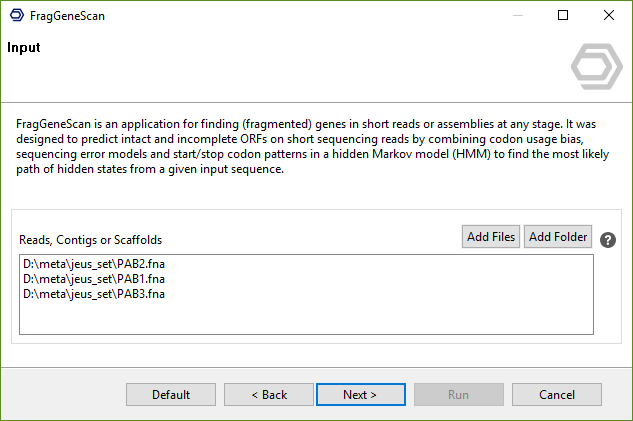
Figure 1. FragGeneScan wizard: input page.
Configuration
- Type of Data: Decide between short sequence reads or assembled sequences as input.
- Model for Input Data: Select the model that matches the input data.
complete: for complete genomic sequences or short sequence reads without sequencing error.sanger_5: for Sanger sequencing reads with about 0.5% error rate.sanger_10: for Sanger sequencing reads with about 1% error rate.454_5: for 454 pyrosequencing reads with about 0.5% error rate.454_10: for 454 pyrosequencing reads with about 1% error rate.454_30: for 454 pyrosequencing reads with about 3% error rate.illumina_5: for Illumina sequencing reads with about 0.5% error rate.illumina_10: for Illumina sequencing reads with about 1% error rate.
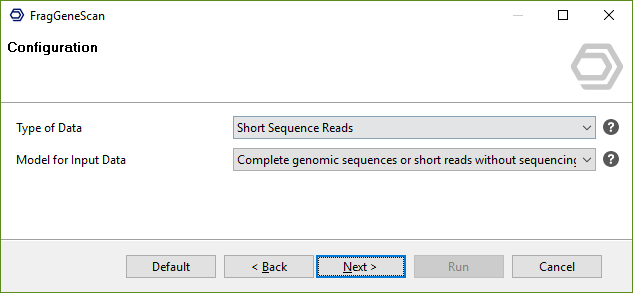
Figure 2. FragGeneScan wizard: configuration page.
Output
- Nucleotide Fasta: Select a file location for the genes multi fasta output.
- Amino-Acid Fasta: Select a file location for the protein sequences multi fasta output.
- GFF: Select a file location to save the gene feature format file.
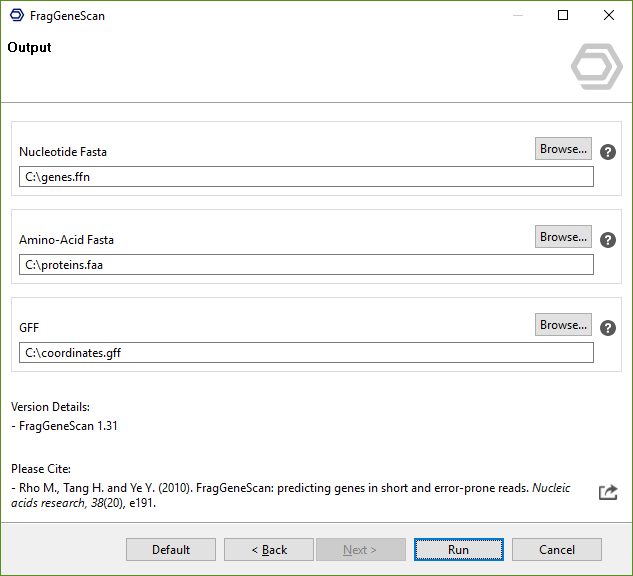
Figure 3. FragGeneScan wizard: output page.
OmicsBox Engine
This tool can be run from the command line via the OmicsBox Engine.
Command: omicsbox frag-gene-scan [options]
Inputs
| Flag | Type | Required | Description |
|---|---|---|---|
--i-sequences |
file (multiple) | Yes | Reads, Contigs or Scaffolds |
Parameters
| Flag | Type | Default | Range / Candidates | Required | Description |
|---|---|---|---|---|---|
--input-data |
enum | 0 | 10 |
No | Type of Data |
--training-file |
enum | complete | completesanger_5sanger_10454_5454_10454_30illumina_5illumina_10 |
No | Model for Input Data |
--chart-format |
enum | box | boxpngpdfcsv |
No |
Parameter relationships
| Flag | When | Effect | Affected flags |
|---|---|---|---|
--input-data |
1 |
disables | --training-file |
Global options (
--local-folder,--cloud-folder,--output-format,--config,--detach,--verbose, …) are shared by every Engine tool and are not repeated here — see the OmicsBox Engine reference.
References
- Rho M., Tang H. and Ye Y. (2010). FragGeneScan: predicting genes in short and error-prone reads. Nucleic acids research, 38(20), e191.
- Trimble WL., Keegan KP., D'Souza M., Wilke A., Wilkening J., Gilbert J. and Meyer F. (2012). Short-read reading-frame predictors are not created equal: sequence error causes loss of signal. BMC bioinformatics, 13, 183.