Prodigal
Introduction
Prodigal provides fast, reliable protein-coding gene prediction for prokaryotic genomes. Prodigal's algorithm for gene prediction follows the basic principle of KISS (Keep It Simple, Stupid). Compared to other methods, Prodigal's naive log-likelihood functions seem deceptively simple. Despite its lack of complexity, with no Hidden Markov Model and no Interpolated Markov Model, Prodigal nonetheless achieves good results. (Figure 1, Figure 2, and Figure 3)
Key features:
- Predicts protein-coding genes: Prodigal provides fast, accurate protein-coding gene predictions.
- Handles draft genomes and metagenomes: Prodigal runs smoothly on finished genomes, draft genomes, and metagenomes.
- Runs unsupervised: Prodigal is an unsupervised machine learning algorithm. It does not need to be provided with any training data, and instead automatically learns the properties of the genome from the sequence itself, including RBS motif usage, start codon usage, and coding statistics.
- Handles gaps and partial genes: The user can specify if Prodigal should build genes across runs of N's as well as how to handle genes at the edges of contigs.
- Identifies translation initiation sites: Prodigal predicts the correct translation initiation site for most genes and can output information about every potential start site in the genome, including confidence score, RBS motif, and much more.
Input
Contigs or Scaffolds: Select files that contain reads or assembled sequences.
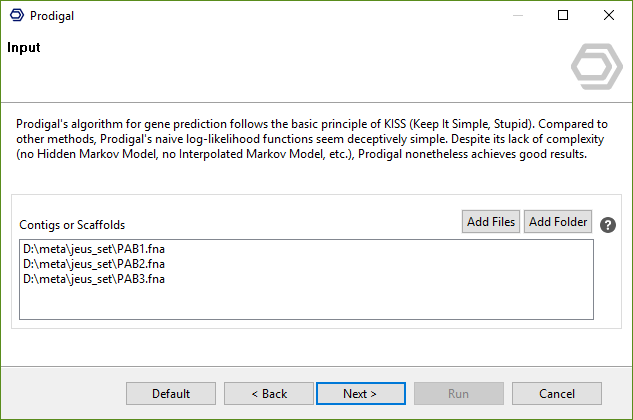
Figure 1. Prodigal wizard: input page.
Configuration
- Closed Ends: Force genes to have start and stop codon, partial genes are not reported.
- Genetic Code: Specify a translation table to use. "auto" will try 11 and then 4 automatically, otherwise the selected genetic code (1-25) will be used.
- Treat Runs of N as Masked Sequence: Tells Prodigal not to build genes around sequences of Ns.
- Bypass Shine-Dalgarno Trainer: Bypass Shine-Dalgarno trainer and force a full motif scan.
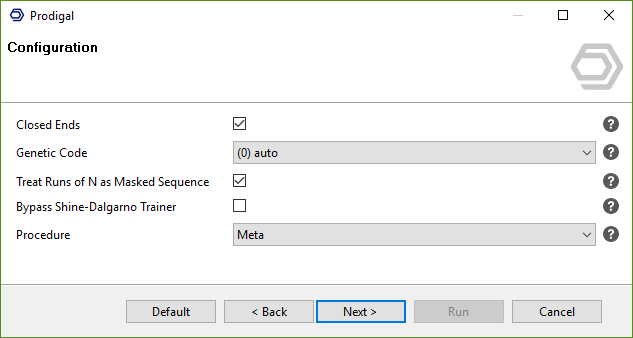
Figure 2. Prodigal wizard: configuration page.
Output
- Nucleotide Fasta: Select a file location for the genes multi fasta output.
- Amino-Acid Fasta: Select a file location for the protein sequences multi fasta output.
- GFF: Select a file location to save the gene feature format file.
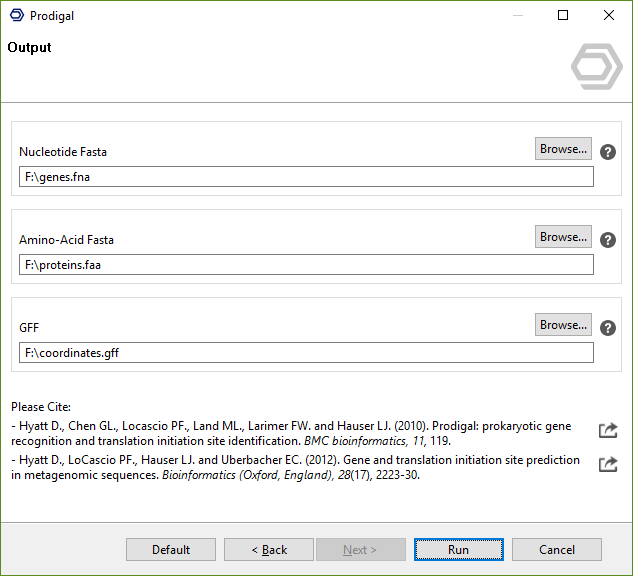
Figure 3. Prodigal wizard: output page.
OmicsBox Engine
This tool can be run from the command line via the OmicsBox Engine.
Command: omicsbox prodigal [options]
Inputs
| Flag | Type | Required | Description |
|---|---|---|---|
--i-sequences |
file (multiple) | Yes | Contigs or Scaffolds |
Parameters
| Flag | Type | Default | Range / Candidates | Required | Description |
|---|---|---|---|---|---|
--closed-ends |
boolean | false | No | Closed Ends | |
--genetic-code |
enum | 0 | 012 |
No | Genetic Code |
--masked-ns |
boolean | false | No | Treat Runs of N as Masked Sequence | |
--skip-shine-dalgarno |
boolean | false | No | Bypass Shine-Dalgarno Trainer | |
--procedure |
enum | meta | singlemeta |
No | Procedure |
--chart-format |
enum | box | boxpngpdfcsv |
No |
Global options (
--local-folder,--cloud-folder,--output-format,--config,--detach,--verbose, …) are shared by every Engine tool and are not repeated here — see the OmicsBox Engine reference.
References
- Hyatt D., Chen GL., Locascio PF., Land ML., Larimer FW. and Hauser LJ. (2010). Prodigal: prokaryotic gene recognition and translation initiation site identification. BMC bioinformatics, 11, 119.
- Hyatt D., LoCascio PF., Hauser LJ. and Uberbacher EC. (2012). Gene and translation initiation site prediction in metagenomic sequences. Bioinformatics (Oxford, England), 28(17), 2223-30.
- Trimble WL., Keegan KP., D'Souza M., Wilke A., Wilkening J., Gilbert J. and Meyer F. (2012). Short-read reading-frame predictors are not created equal: sequence error causes loss of signal. BMC bioinformatics, 13, 183.