rRNA Removal with SortMeRNA
Introduction
Applying NGS technologies for metatranscriptomics profiling is common practice. It allows for full extraction of coding and non-coding RNA in a community of organisms and has become particularly important for samples that cannot be cultivated outside their native environment. The extracted RNA can be roughly divided into mRNA (messenger) and rRNA (ribosomal). It is necessary to separate both types because mRNA helps to understand the sample’s gene expression patterns, while rRNA reveals information on the community’s structure and biodiversity (phylogenetic analysis and taxonomic classification). rRNA can comprise up to 90% of total RNA but does not contribute to the gene expression pattern analysis. Even with pre-sequencing procedures to isolate mRNA, up to 15% rRNA may still remain in silico and can possibly be further diminished with tools like SortMeRNA. OmicsBox offers SortMeRNA to separate both types of RNA.
- Sequencing Data: Choose the type of input data: fasta, single-end, or paired-end. If paired-end is selected, two files per sample are required and the file pattern has to be provided.
- Reads:Select files that contain the desired input data.
-
Paired-end configuration: When working with paired-end libraries, a so-called pattern has to be established to help the software distinguish between upstream and downstream read files. Per default, we assume the following pattern:
-
upstream: SampleA_1.fastq
- downstream: SampleA_2.fastq
For SRR037717_1.fastq and SRR037717_2.fastq as up and downstream files, please select "_1" and "_2" respectively for the patterns.
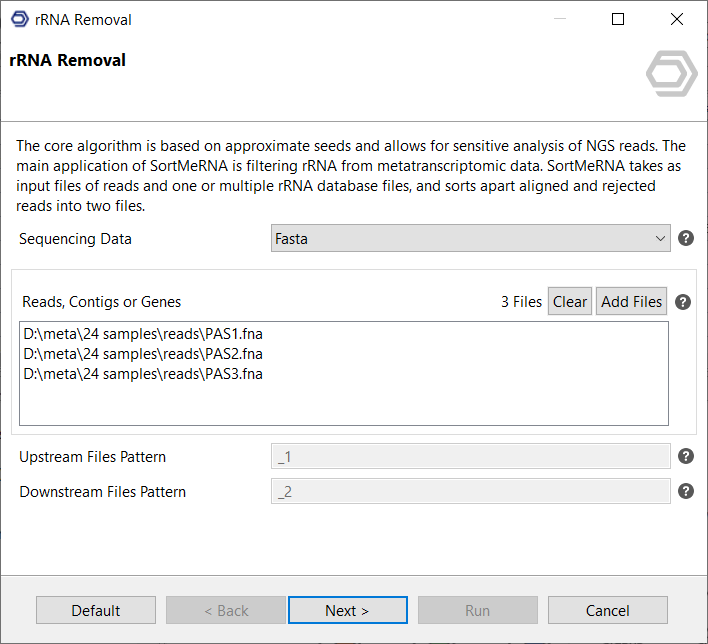
Figure 1
Several rRNA databases are available, and user compiled databases can also be provided by selecting Additional Database in Target Databases. This allows uploading own Fasta files with the Additional Database file selection widget.
Paired Mode configures how SortMeRNA handles read pairs with ambiguous alignments:
- Paired In: With one aligned read, both are considered aligned.
- Pared-out: If one read can not be aligned, both are considered not-aligned.
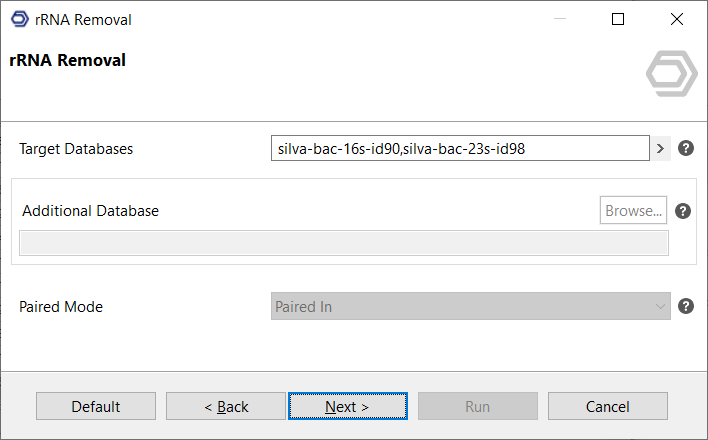
Figure 2
Save rRNA and mRNA separately and discard results if not desired.
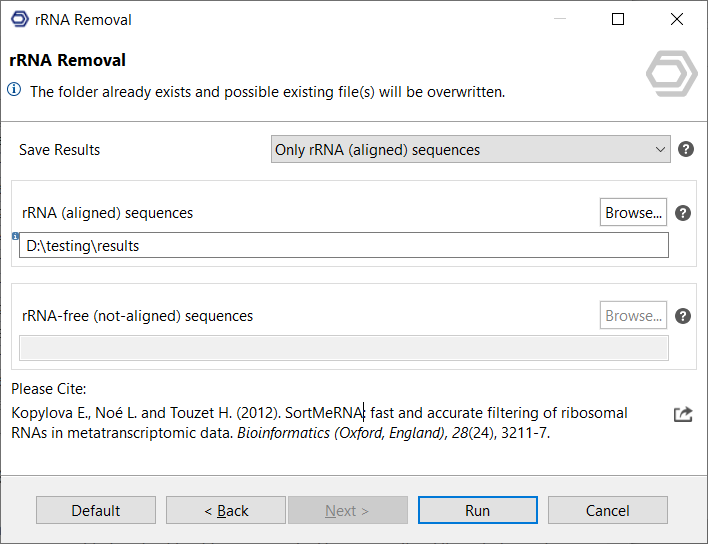
Figure 3
OmicsBox Engine
This tool can be run from the command line via the OmicsBox Engine.
Command: omicsbox sort-me-rna [options]
Inputs
| Flag | Type | Required | Description |
|---|---|---|---|
--i-read-files |
file (multiple) | Yes | Reads |
--i-additional-database |
file | No | Additional Database |
Parameters
| Flag | Type | Default | Range / Candidates | Required | Description |
|---|---|---|---|---|---|
--sequencing |
enum | fastq_pe | fastafastq_sefastq_pe |
No | Sequencing Data |
--upstream-pattern |
string | _1 | No | Upstream Files Pattern | |
--downstream-pattern |
string | _2 | No | Downstream Files Pattern | |
--result-mode |
enum | only_other | only_alignedonly_otherboth |
No | Save Results |
--paired-mode |
enum | paired_in | paired_inpaired_out |
No | Paired Mode |
--databases |
enum (multiple) | rfam-5.8s-database-id98,rfam-5s-database-id98,silva-arc-16s-id95,silva-arc-23s-id98,silva-bac-16s-id90,silva-bac-23s-id98,silva-euk-18s-id95,silva-euk-28s-id98 | rfam-5.8s-database-id98rfam-5s-database-id98silva-arc-16s-id95 |
No | Target Databases |
Parameter relationships
| Flag | When | Effect | Affected flags |
|---|---|---|---|
--sequencing |
fasta |
disables | --upstream-pattern, --downstream-pattern, --paired-mode |
--sequencing |
fastq_se |
disables | --upstream-pattern, --downstream-pattern, --paired-mode |
--result-mode |
only_aligned |
enables | SortMeRnaParameters.outputAligned |
--result-mode |
only_aligned |
disables | SortMeRnaParameters.outputOther |
--result-mode |
both |
enables | SortMeRnaParameters.outputAligned |
--databases |
Additional Database |
enables | --i-additional-database |
Global options (
--local-folder,--cloud-folder,--output-format,--config,--detach,--verbose, …) are shared by every Engine tool and are not repeated here — see the OmicsBox Engine reference.
References
Evguenia Kopylova, Laurent Noé, Hélène Touzet, SortMeRNA: fast and accurate filtering of ribosomal RNAs in metatranscriptomic data, Bioinformatics, Volume 28, Issue 24, December 2012, Pages 3211–3217, https://doi.org/10.1093/bioinformatics/bts611